The collection
The Art Recovery Commission
From November 1944 through December 1949, the Art Recovery Commission (CRA) was responsible for conducting research related to the recovery of works of art, in coordination with the Office of Private Property and Interests (OBIP), which oversaw their restitution. The works were found primarily in storages discovered by Allied troops in Germany and Austria.
Claims submitted to the Commission involved approximately 100,000 works of art and art objects. Approximately 45,000 were returned to their rightful owners between 1944 and 1950.
The CRA’s archives are held at the Archives of the Ministry for Europe and Foreign Affairs, at the La Courneuve site. They have been digitized and are available online since 2023. This collection constitutes the primary French source of information on the spoliation of cultural property committed against Jewish individuals and organizations (private individuals, the Alliance Israélite Universelle, consistories) and non-Jewish individuals and organizations (private individuals, museums, libraries, private individuals) during World War II.
The 2,443 named claims files submitted by victims to the CRA and the OBIP form the core of the collection (CRA and OBIP series, catalogued as 209SUP/1-88 and 209SUP/591-737). These files consist of correspondence between the victims and the administration, as well as lists and descriptions of the looted property, sometimes accompanied by photographs (the “Photo Albums” series, cataloged as 209SUP/933 through 1044), as well as release forms in the event of the return of property.
The photo albums (209SUP/933 to 1044)
These photo albums contain a collection of approximately 30,000 photographs, indexed and arranged alphabetically by person (victims, plunderers) or by agency or institution (ERR, Collecting Points, Dorotheum, etc.) (see the inventory).
The majority of the photographs come from claims files submitted to the Art Recovery Commission. These photographs were provided by the dispossessed families to support their claims. Approximately one thousand of these photographs are interior shots featuring works of art.
Spolia
Search
The Spolia tool allows users to perform a reverse search within the collection of photo albums (209SUP/933 to 1044). Developed by the Mission for the Research and Restitution of Looted Cultural Property (M2RS) of the Ministry of Culture in cooperation with the Archives Directorate of the Ministry for Europe and Foreign Affairs, it was created by Antoine Lavacquery, a digital humanities engineer.
The Spolia reverse image search engine compares the image uploaded by the user to images from the 209SUP photo albums. The score shown indicates how closely the uploaded image matches those in the collection: the closer the score is to 0, the more similar the two images are.
A manual segmentation of the interior photographs allows the uploaded image to be compared with the paintings hanging on the wall. Sculptures, works of art, or furniture present in these interiors could not always be included for technical reasons.
In Spolia, each image is named using its box number and the number of the digitized view, available online on the Diplomatic Archives website. You can click on the image to access the digitized collection on the Diplomatic Archives website.
Example:
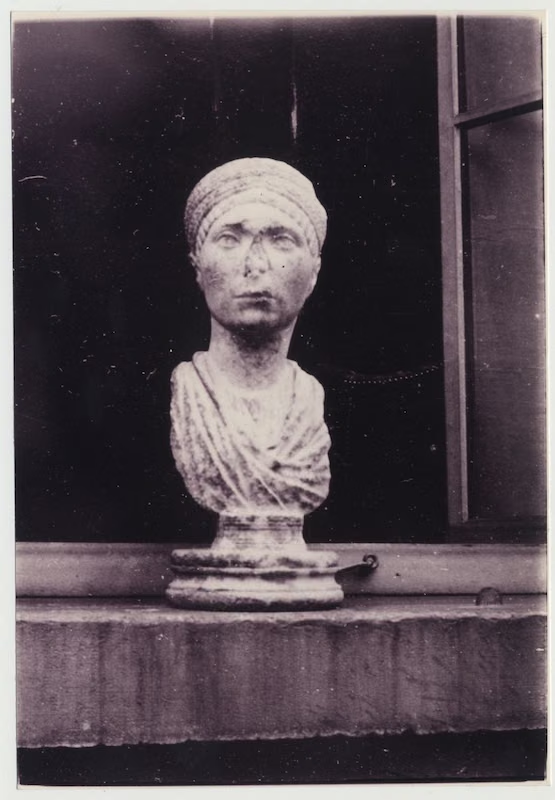
This photograph is named 209SUP_983_025.jpg, which corresponds to box 209SUP/983 and view 25 of the digitized collection available on the Diplomatic Archives website.
The next page, page 26, shows the name of the victim of spoliation, Alphonse Kann. Each photograph is digitized on both the front and back. The name of the victim of spoliation is written on the back of the photograph.
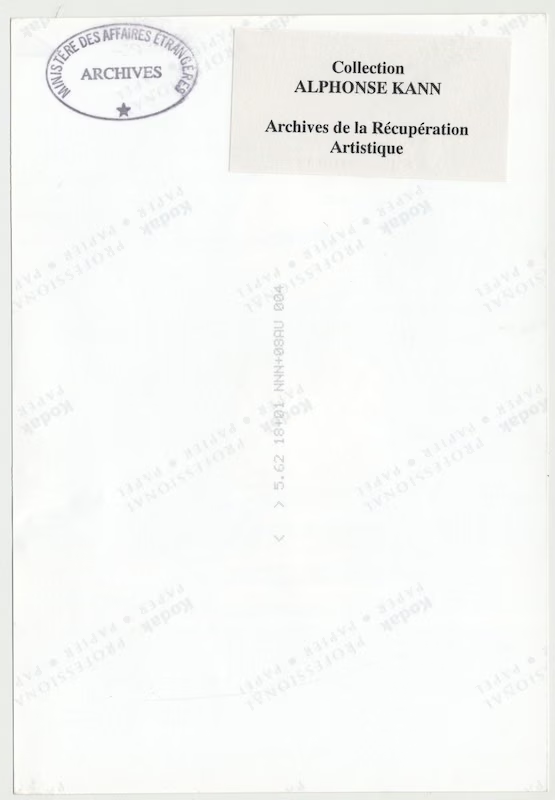
Further research must then be conducted within the collections, particularly in the personal files (inventory). Thus, to understand the confiscation of Alphonse Kann’s property, you must check his personal file 209SUP/3, number 45.35, which has been digitized and is accessible online starting at page 543.
If a match appears between the uploaded image and an image from the 209SUP photographic collection, you can report it to the M2RS.
Analysis of the Results
A few precautions should be taken when interpreting the results:
-
Just because there is no match does not mean the work was not looted; in fact, not all looted works are included in this collection of photographs (other sources should be consulted).
-
Just because there is no match does not mean the photograph is not in the 209SUP collection; poor image quality may prevent a match.
-
Just because there is a match does not mean the artwork was looted (for example, not all artworks appearing in pre-war interior photographs were necessarily looted).
-
If a match is found, the artwork may have been looted and then returned; in all cases, you must consult the complete file to understand what happened.
Exploring a Photographic Collection with Multiple Origins
It is also possible to explore the collection using predefined tags or to perform a free-text search.
This collection is rich and complex. While the majority of the photographs come from claims filed with the Art Recovery Commission, some photographs belong to other collections.
A few examples:
| 209SUP/991 Musée du Jeu de Paume | This folder of photographs documents Goering’s visit to the Jeu de Paume and the exhibition of recovered works of art (Musée de l’Orangerie, 1946). Starting with view 247, there are photographs by Rose Valland. |
| 209SUP/992 Members of the ERR | The Einsatzstab Reichsleiter Rosenberg (ERR), led by Nazi official Alfred Rosenberg, was represented in France by Baron Kurt von Behr. Beginning in September 1940, this agency was tasked with confiscating the property of Jews and Freemasons in occupied Europe. This subseries contains photographic portraits of members of this organization (see also the ERR archives). |
| 209SUP/968, view 583, Cambrai Museum | In this file, the Dijon Museum is searching for the Pellerey bas-relief that disappeared during the Occupation. |
| 209SUP/995, fabric sample, bookplate | Families did not always have photographs of their missing objects; some were able to send drawings, made from memory, or even fabric samples to help identify the looted furniture. View 417 : ROSENTHAL (Erwin) - drawings. View 559 : ROYS (Jacques) (Marquis des) - fabrics. |